Dispatch no. 7
5 May 2000
Well, here
we are still. The world was supposed to have ended (again), on Friday the 5th
of May, but it seemed that the doomsday prophets had gotten things wrong again.
I wonder
whether they are disappointed. All those planets perfectly lined up, combining
their gravitational pull in a vicious conspiracy, aimed at dragging our
continents into the sea, or making the earth wobble – and then nothing
happened. At least, I hear they’ll have another chance in two years’ time when
it is said that the planets will pulling the same trick again.
.svg/505px-Coat_of_Arms_of_South_Africa_(1932-2000).svg.png) |
| The old coat of arms of South Africa. |
Our
national celebration of international communist day on May, 1st,
caused far more excitement than the planets did, and on the previous Friday,
our so-called “Freedom Day” was celebrated with most enthusiasm of all. The old
South African coat of arms was officially thrown out, and replaced with a
cryptic ethnic design that didn’t draw too many favourable comments, it seems.
Our old motto used to be “Ex unitate vires” – unity is strength. Now it
is something, written in an old bushman language that became extinct more than
a hundred years ago. Nobody can read it, because bushmen have sounds that are
represented by unusual symbols that nobody knows how to pronounce. The new coat
of arms was officially unveiled and bolted onto the walls of the Union
Buildings, which is to South Africa what the White House is to America. And
then, a night or two later, some law students were caught, trying to steal the
brass coat of arms. One can only shake one’s head in wonder...
 |
| The new coat of arms of South Africa, bearing a motto which nobody can pronounce. |
At the
moment, the second covering of snow for the season seems to be melting off the
Drakensberg mountains. A second thunder storm erupted, and destroyed the
telephone infrastructure a second time, thus taking care of internet
communications and the like, yet again. Rain in winter is almost unknown in our
hothouse environment, and here it has happened twice in ten days! As before
though, the telephone company has really taken its time fixing things. There’s
nothing I can do about it, I’m afraid.
The news from
Zimbabwe is still pretty much the same. President Mugabe has finally made it
clear that one way or another, he is going to disown 50% of the white farms
despite all protests. Meanwhile, the United Nations and Great Britain is
continuing making plans and arrangements to evacuate all the white people from
Zimbabwe, as far as is possible. According to reports, they are even making
plans for making a real emergency military evacuation if this should prove
necessary. President Mugabe has publically said, however, that he will give all
assistance to “get the whites out of the country.” The consulate in Harare has
been overwhelmed by applications from white citizens of Zimbabwe for travel
documents and foreign citizenships – mostly for England. Mugabe is still blaming
the whites in his country for nearly everything that has gone wrong in so far.
The farmers have also been heavily criticized for not having planted any winter
crops, and it still looks as if severe food shortages and possibly famine might
lie ahead for the country. Their economy is now really in tatters, and with
Zimbabwe’s 15,000 soldiers still fighting in the Congo, the drain on their
remaining reserves must be enormous.
 |
| President Robert Mugabe of Zimbabwe. |
The new
elections should take place by next month, it seems, and the ruling party is
taking every more desperate steps to try and cling to power. Even though the
farm invasions have been ordered to a halt by the president, they are still
continuing. Meanwhile a report has been made public, in which an old Zimbabwe
government official is named as being the master brain behind the
land-grabbing. This same man is a known mass-murder from the time of the
Rhodesian bush war. In South Africa, President Thabo Mbeki has continued to
remain silent about the situation of lawlessness in his neighbouring country.
Even a lot of the traditionally very liberal, heavily left-wing media and
organizations have now firmly concluded that Mr. Mbeki is approving what is
happened in South Africa’s neighbouring state, although he might not be
entirely happy at all the fuss that has resulted from it.
One of the
things that the Zimbabwean crisis has brought, is a yet further devaluation of
the Rand. It now stands at the lowest level in many years, and the stock market
is still very depressed as foreign investors have been selling off South
African money reserves, to a large degree in reaction to president Mbeki’s
continued silence and obvious approval. South Africa’s minister of agriculture
and land affairs has this week declared that the same thing will definitely not
happen in South Africa, but she added that any disowning of land will be “to
the advantage of all the country’s citizens...”
 |
| President Thabo Mbeki of South Africa. |
The history
of Zimbabwe is an interesting one. A very bloody one too. President Mugabe
accuses Great Britain of having “stolen the land” from the Zimbabweans. In a
way, this is actually quite true, but in a rather surprising manner. In a way,
Zimbabwe was “stolen” by only one Englishman, and Great Britain became the
receiver of a “stolen gift.” Yes, many people know that Great Britain only
accepted the rule over Zimbabwe under great protest. Here’s how it happened:
What we
know today as Zimbabwe, was originally populated by primitive Bushmen, and much
later still, small numbers of other very primitive black races – of whom only
the smallest numbers are still to be found. Some of these ancient races would
include the very primitive Batonkas or even the mysterious two-toed tribe of
the Zambezi. This is an amazing people who have the distinction of having the
most unique feet in the world. Due to a genetic peculiarity, this tribe has a
big tendency to have “ostrich feet” – Y-shaped feet with only two massive, long
toes in front. One big and long one, and one smaller. Even today, they are a shy
and rarely-seen tribe, who speak a difficult and ancient language, and who are
noted for being extremely fast runners. But all of that is another story
entirely...
After these
primitive tribes came the Mashona people, who displaces the original
inhabitants and settled in greater numbers. They were a relatively peaceful
nation that survived off the land and raised a few crops. They have always been
relatively non-violent as a people. For many decades peace prevailed, but then
came the early 1800's. Far off in the green hills of Natal, in present-day
South Africa, a military dictator by the name of Shaka, king of the Zulu,
suddenly rose to become the most feared ruler in the history of sub-Saharan
Africa. Shaka Zulu would later be called the “Black Napoleon of Africa.”
 |
| Shaka, king of the Zulu who murdered more people than any other in the history of sub-equatorial Africa. |
Under his
rule, Shaka violently conquered and united many different Nguni races, and
called them collectively the “amaZulu” – or people of heaven. The story of
Shaka Zulu is incredibly fascinating, and many books have been written about
his life. Many people have also seen the television series that was made about
his life. What the TV series didn’t really properly show, was how Shake had
gone berserk after the death of his beloved mother. His rule had always been
characterized by the most brutal of wars, and the most cruel of killings and
murders. All done on a staggering scale. During his reign, Zululand flowed with
blood continuously. After his mother, Nandi’s death, however, Shaka swept out
across the South African highveld, sending his armies across the barren plains
like black waves of death that consumed everything in its path. In an effort to
make all of Southern Africa grieve along with him, he eventually murdered innumerable
multitudes of his own people – not even mentioning most of the neighbouring
tribes which he completely wiped off the face of the map, or displaced to
distant geographical regions to this very day. The numbers are estimated in the
hundreds of thousands, and indeed, have even been estimated to have been in
excess of a million people.
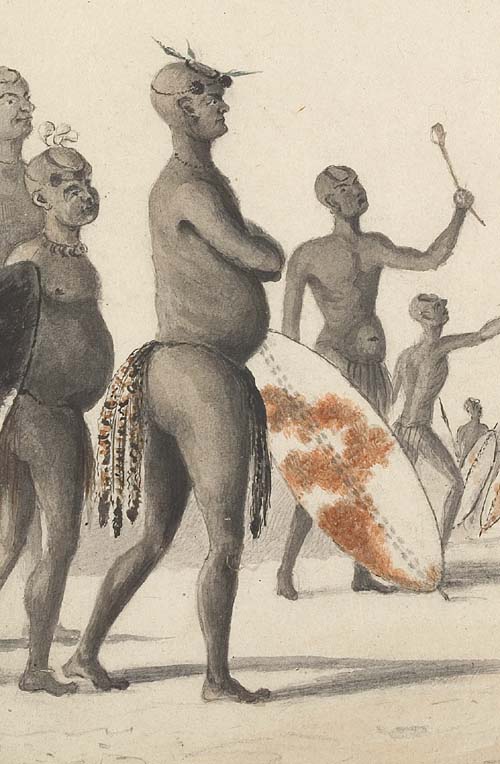 |
| Mzilikazi - king of the Matabele and conqueror of the Mashona. |
During this
background, the groundwork for today’s Zimbabwe was laid. It all began when Mzilikazi,
one of Shaka’s great generals and tribal chiefs, rebelled against him and
refused to pay Shaka his war booty, rather daring him to come and fetch what
Shaka considered to be his. This truly must rank as one of the dumbest moves in
history. Shaka move out against Mzilikazi with the ferocity of a wounded
buffalo. Mzilikazi, however, must have realized his mistake, and very wisely
concluded that his only safety lay in running as far as his legs could carry
him. Knowing Shaka, Mzilikazi realized that hell was truly about to descend on
him, so he took his cattle, and ran for his life. Mzilikazi fled helter-skelter
all across the country, with Shaka’s impis hot on his heels all the time. Yet,
instead of simply running away, Mzilikazi killed everything in his way. He
slaughtered all and any tribes he encountered, swallowing up whom he could, and
adding them to his ranks.
Shaka’s men
eventually stopped the chase, but Mzilikazi only stopped running when he
eventually reached the land of the Mashona. Until then, his flight had been
marked with colossal rivers of blood, but when he reached the land of the
Mashona, he slaughtered them most brutally in awesome numbers. This Mzilikazi
became the undisputed ruler of Mashonaland, and his people became known as the
Matabele people – the rulers of the land of Zimbabwe. After Mzilikazi’s death,
his son, Lobengula became king. “Fat king Lob” as the British called him,
wasn’t as effective a king as his father, though, and his weaknesses soon
manifested themselves.
Then came
the late eighteen hundreds, and gold was discovered in Zimbabwe. Far off in
South Africa, a young man by the name of Cecil John Rhodes sat dreaming many a
day as he watched his workers toil to take out the diamonds from his new
diamond claims on the Kimberley diamond diggings. He had come from a humble
background, but he had illustrious dreams. It was to combine all of Africa
under British rule, and then add the whole of the Middle-East, combine it with
Britain’s other colonies such as Australia, India and Canada, and many of the Far
East island regions. After that, his plan called for “the recovery of the
United States,” and when all of that was completed and the English-speaking
world was united, he planned on ruling the world, together with Germany in what
he called his “Pax Teutonica” – and have world peace for ever more.
 |
| Cecil John Rhodes - the man "who dreamed in continents." |
Diamonds
soon made Rhodes one of the richest men in the world, and his money and determination
also made him the Prime Minister of the Cape Colony and thus an immensely
powerful man. But Rhodes needed more money still. What he needed was to control
the world’s monetary system, and for that to happen, he needed to control the
world’s gold supply. He was already in the process of gaining control over much
of the world’s biggest new gold find at Johannesburg, (and ultimately he helped
to start the Boer War in order to get it) but he needed more. This was when his
eyes fell on present-day Zimbabwe.
 |
| King Lobengula of the Matabele - possessor of a calabash of diamonds. |
Of course,
there was another reason too. For years, old king Lobengula of Zimbabwe, had
been sending his subjects to go and work at Rhodes’ diamond mines in Kimberley.
All his workers were instructed to steal and bring back the biggest and best
diamonds they could find, for their king’s treasure chest. In those days, it
was reported by men who claimed to have seen it with their own eyes, that
Lobengula possessed a very large pot full of the most wonderful gems in the
world. By the most popular estimates, Lobengula’s treasure was valued at over
ten million pounds sterling. Certainly one of the biggest private fortunes in
the world at that time.
Rhodes
meant to have Mashonaland, as well as Lobengula’s diamonds, if he was going to
rule the world, and he made his plans accordingly. It took several years for
everything to work out, but in the end, what Rhodes did was something
wonderfully amazing. He actually managed to bamboozle some of the most noted,
and most important British public and political figures into financing a
tremendously daring scheme for stealing Mashonaland from under old “king Lob.”
 |
| The battle at Shangani, during the First Matabele War. |
Through
methods of blackmail, murder, treason and large-scale trickery, and by even
turning Lobengula into a morphine-addict, he managed to obtain from Lobengula
the sole right to mine all minerals in Mashonaland. Then he raised a private
army, funded by British tax-payers’ money (amazingly), and sent them marching
in. Lobengula was driven back and bullied for two or three years, and finally,
when he could take it no more, Rhodes forced a war. The battles were short and
tremendously bloody. Before Rhodes’ trained army and his Maxim machine guns,
Lobengula’s proud and once blood-thirsty army was mown down like wheat stalks,
and within a matter of days it was destroyed completely for all practical
purposes.
The rest
was easy. Lobengula fled into exile, and died of syphilis and a broken heart
and spirit. His body was sealed into an unknown cave by his most trusty
lieutenants, and so were his diamonds. Nobody has ever found the treasure of
king Lobengula, and to this day people are searching for what must surely still
be one of the biggest lost treasures the world has ever known. The really funny
part is that the British government initially wanted absolutely nothing to do
with Mashonaland. But Rhodes eventually forced the gift so hard into its hands,
that the British Empire could simply not refuse the enormous gift. Rhodes
became one of only two men in modern times, who had a country named after them.
The other was Simon de Bolivar of Bolivia.
And this is
how “Rhodesia” became a British colony for more than seven decades after. We
all know how it ended: Finally, under communist instigation and with communist
aid and backing, the black tribes of Zimbabwe revolted against British rule and
after a long and very bitter civil war which only ended 20 years ago. The white
colonists who had settled in Rhodesia since the 1890's, and had built up and
worked the land, had to buy back the land they occupied from the new government,
or were legally allowed to keep what they had. And today, just over a 100 years
later, they are being blamed for all that ever went wrong in that country’s
troubled past, and are being robbed of what they had inherited from their
ancestors. Land which had originally been stolen hundreds of years ago, and
whose original owners are now extinct as a people.
Of
Mzilikazi’s enormous murder-campaigns, and the extermination of the original
landowners, the Bushmen, nothing is said. History shows that Mugabe’s people
have been just as much land-grabbers as anybody else that they’re accusing. It
is just one of those amazing facts of history that stand glowing in its
enormity, yet which goes unnoticed by the world. It is a weird and wonderful
tale that Mugabe doesn’t like being told. It isn’t hard to figure out why...
 |
| Cecil John Rhodes making peace with the Matabele at the end of the Second Matabele War. |
And with
that, all that is left to be said is that this week hasn’t brought much action
with it. In Botswana a young safari guide was killed by an elephant. He was
guiding an elephant safari (where excited tourists do game viewing from the
backs of tame elephants in a national park), when he was suddenly charged by an
enraged elephant. He fired three warning shots, and was then promptly trampled
to mush. Strange, because he has known and worked with elephants for years,
having made wildlife films in the past. I guess it was a mistake that killed
him, more than anything else, though. Assuming that he had been armed with a
big game calibre rifle, it would seem that he had fired all his rounds at the
elephant, and when he realized it wasn’t just a mock-charge, it was too late:
he had no more rounds to kill the beast with. A tragic mistake... Which reminds
me, I’ve only got about three brain cells still left awake right now, and it is
perhaps a good time to head for bed at this hour. An early start waits
tomorrow, and much needs to be done. I still planned on saying something about
the Rain Queen and the Elephant highways, but I guess that will have to wait
for another time.
Have a
wonderful week, try to avoid buying “stolen” property, and always remember
never to fire your last shot as a warning shot!
Herman
 |
| The Great Zimbabwe Ruins. |
Picture:
This
picture was taken of the Ruins of Great Zimbabwe. President Mugabe maintains
that it had been built by his tribe (the Shonas), but this is such a glaring
piece of wishful thinking that nobody even bothers to comment about it. These
ruins are very much older, and some archaeologists believe that they had
originally been built by the ancient Phoenicians. Similar ruins are scattered
all over Zimbabwe. There is, however, an even stranger explanation that is
offered these days – the possibility that the mysterious ruins had been built
by the so-called “Black Jews of Africa.” The story is a long and complicated
one which I can’t tell now, but suffice to say that it is now believed that
hundreds of years ago a southern migration of Jews from ancient Israel, had
eventually reached as far as Zimbabwe. These Jews, is supposed to have
eventually completely mixed into the black nations of Africa. Recently, though,
some high-tech genetic mapping has been done, and according to a big study
conducted from South Africa, it has been determined that a specific part of the
people of Zimbabwe have very definite genetic connections to the Jews of
ancient Israel. They reckon there can be no doubt whatsoever that the “Black
Jews” had real Jews in their ancestry. Another odd fact is that these “Black
Jews” still have many traditional “Jewish” religious rituals, practices and
beliefs, despite not having had contact with Israel and the Jewish religion for
hundreds of years. The great ruins of Zimbabwe have in the past been believed
to have been one of the probable spots where the legendary “Ophir” from
biblical times, might have been. The place where King Solomon received his gold
from, via his men who sailed with the ancient Phoenicians. Indeed, Cecil John
Rhodes believed this very adamantly. Interesting thought. Although many golden artefacts
have been unearthed under these ruins, the ancient gold mines there have never
yielded very much gold at all. These ruins are awesome to behold, though.
Walking through them is an amazing experience – one that mere words cannot
describe...
Image credits: Wikipedia.


